
Partnering in action
Case Studies
What the Green Hydrogen Community Development Toolkit pilot revealed about learning, capacity and partnering
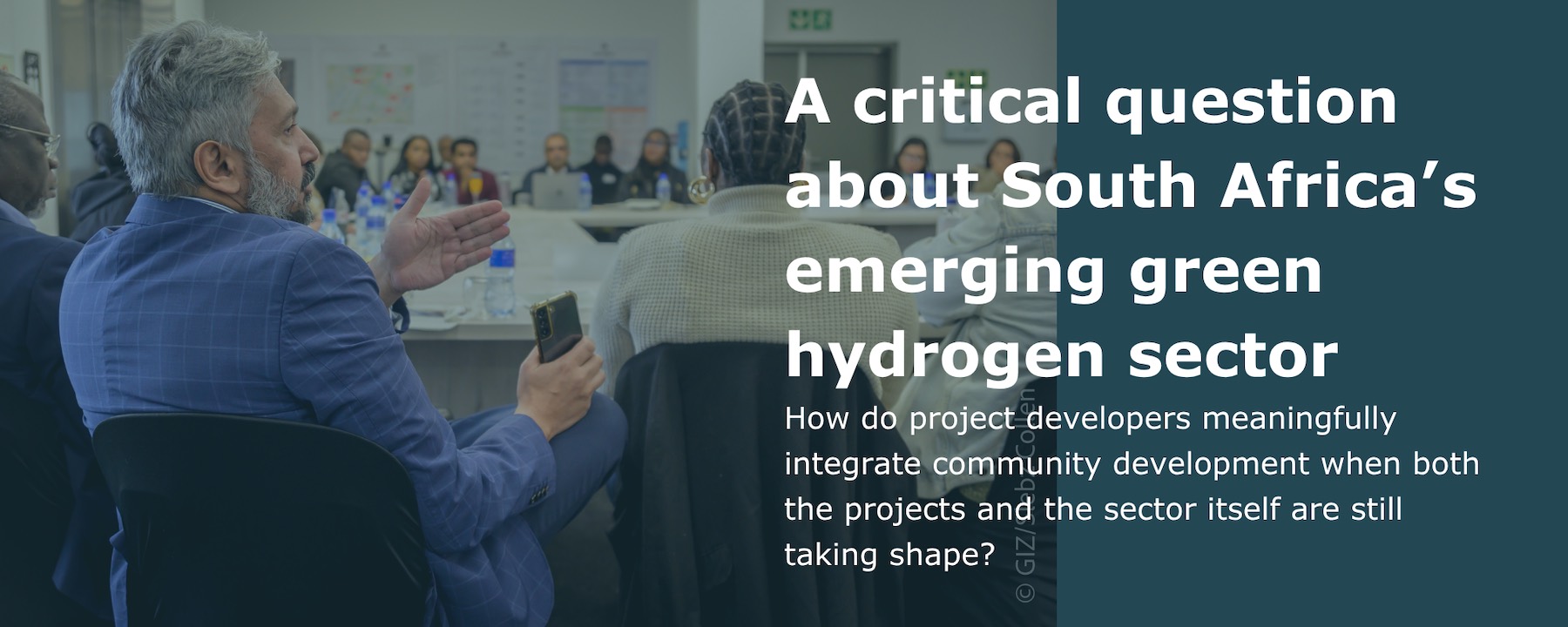
Green hydrogen is often described in terms of what it can produce but seldom in terms of what it will cost. Large-scale industrial projects arrive in municipalities with competing priorities, communities carrying the legacies of previous development promises and operate alongside institutions that must learn to navigate entirely new industries. At a moment when South Africa’s hydrogen pipeline started gathering momentum, a practical question emerged: how do project developers meaningfully integrate community development when both the projects and the sector itself are still taking shape?
Suggested citation: Economic Development Partnership. 2026. What the Green Hydrogen Community Development Toolkit pilot revealed about capability, partnering and learning: a case study. Available: https://wcedp.co.za/impact-green-hydrogen-community-development-toolkit
Why the pilot was needed
The Green Hydrogen Community Development Toolkit (CDTK), published by GIZ’s H₂.SA programme in 2023, sought to provide practical guidance on integrating community development throughout the lifecycle of a hydrogen project.The toolkit itself drew on lessons from the mining sector, where decades of experience have demonstrated both the opportunities and consequences of large-scale industrial development.
Questions around stakeholder engagement, local participation, benefit-sharing and social licence have long shaped extractive industries and are equally relevant for many emerging green sectors, although hydrogen presents a different operating context. Projects are often still in feasibility stages. Investment decisions remain uncertain. Regulatory frameworks are evolving. Dedicated social-performance teams rarely exist at project inception.
The challenge was not whether community development mattered. The challenge was understanding what meaningful community development looks like in an industry that is still defining its own norms and practices.
Recognising this gap between guidance and practice, GIZ partnered with the Economic Development Partnership (EDP) to pilot the toolkit across seven green hydrogen projects over two years. The pilot had four objectives: support developers in applying the toolkit’s tools and methodologies; strengthen institutional and human capability for community development in the hydrogen sector; document lessons to inform policy and sector learning; and produce an updated toolkit grounded in practical experience.
Seven projects, one learning journey
The pilot worked alongside seven green hydrogen projects across South Africa’s Northern Cape, Eastern Cape and Western Cape provinces. These projects represented a diverse cross-section of the emerging green hydrogen landscape.
Some were private-sector consortia, others were publicly anchored initiatives. Some operated within established Special Economic Zones, while others were situated in remote municipal contexts. They ranged from early concept development to pre-construction activities. Their contexts differed but their starting points were remarkably similar.
Community development was seldom understood as a core project capability. Social responsibilities were frequently absorbed by technical or project-management teams. Dedicated budgets for community engagement were uncommon during early project stages. Few projects had specialist social-performance capacity.
Through structured gap analyses, tailored support plans, facilitated workshops and regular check-ins, developers applied the toolkit in real time, examined what the tools revealed and adjusted their approaches as their projects evolved. Rather than treating the CDTK as a static guide, the pilot tested it under real-world project conditions and created opportunities for developers to learn through application.
The approach adopted an Action Learning methodology built around a simple rhythm: plan, act, observe and reflect. More importantly, it created a structured learning partnership in which challenges could be examined collectively and improvements made iteratively.
Building while learning
The pilot demonstrated that emerging sectors rarely arrive with established norms, institutional capability or shared practice. They learn their way into maturity.
Many of the questions confronting developers had no predetermined answers:
- How early should communities be engaged?
- How much information is enough when project timelines remain uncertain?
- How should responsibilities for community development be anchored internally?
- How can municipalities and Special Economic Zones become partners in the work?
These questions could not be answered through a toolkit along because they required experimentation, reflection and collective sense-making. The Action Learning process created opportunities for project teams to test assumptions and adapt their approaches while projects were still malleable. Workshops became spaces for structured inquiry rather than training sessions. One-on-one engagements allowed sensitive issues to be discussed candidly. Group sessions encouraged peer learning across projects facing similar challenges. The process did not remove uncertainty. It made uncertainty navigable
What emerged
The most significant shift in this work was conceptual. Many developers entered the pilot viewing community development primarily through the lens of compliance and risk management. There was understandable caution about engaging communities too early. Teams worried about raising expectations that projects might not ultimately fulfil. Yet project after project revealed something different.
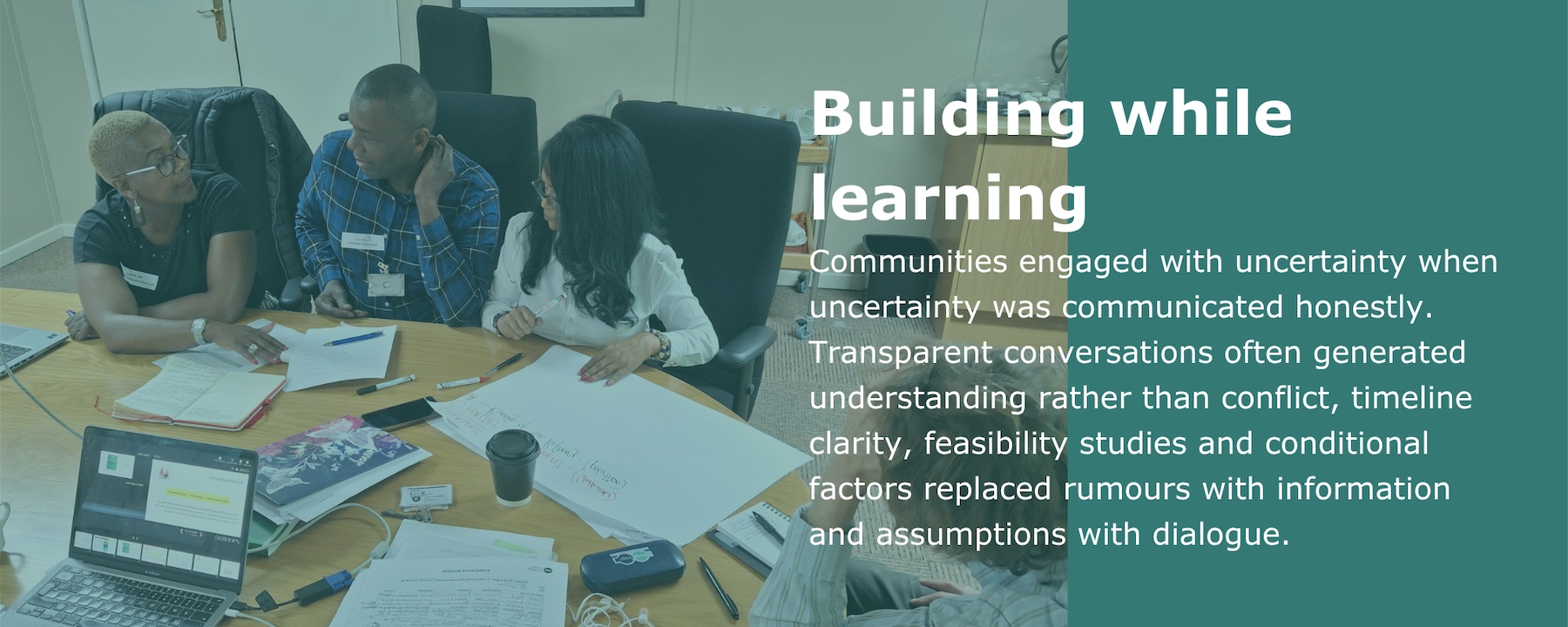
Communities were capable of engaging with uncertainty when uncertainty was communicated honestly. Transparent conversations often generated understanding rather than conflict. Clear messaging about timelines, feasibility studies and conditional factors helped replace rumours with information and assumptions with dialogue. One insight became increasingly difficult to ignore: the cost of silence is often higher than the cost of honest conversation.
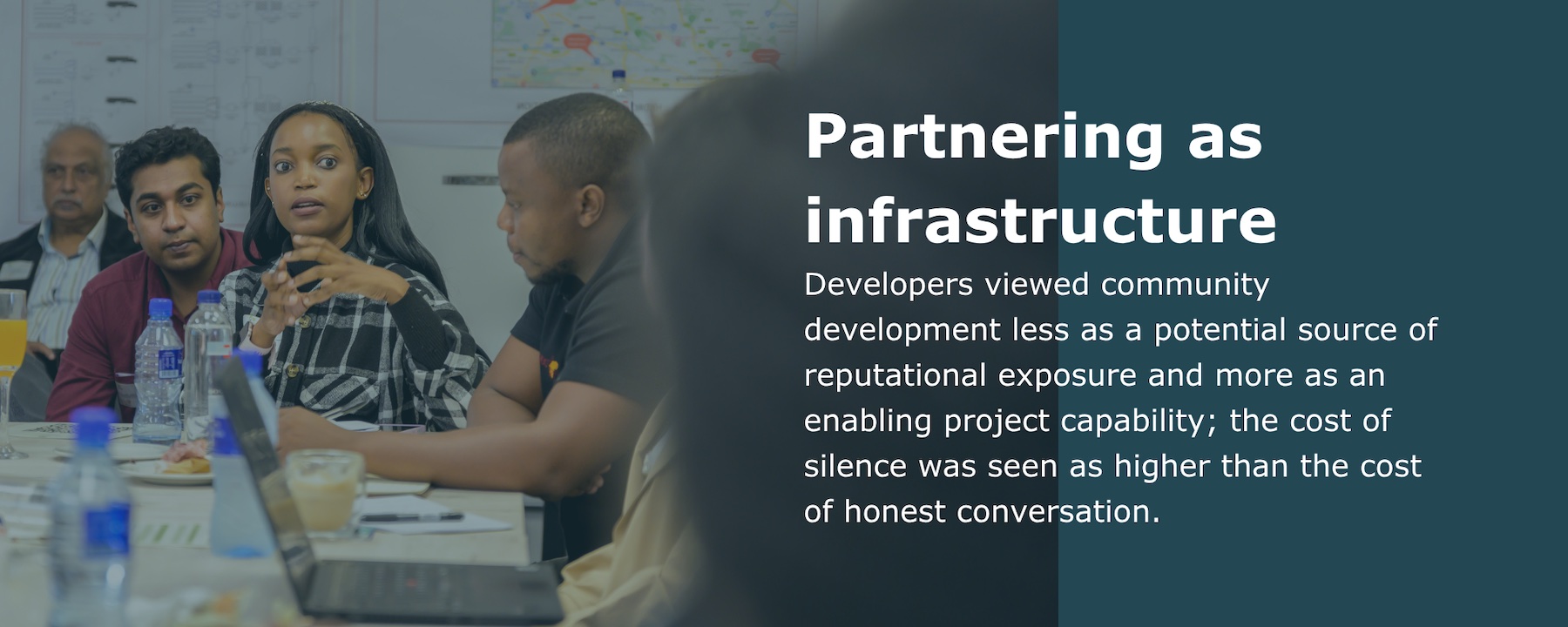
Among the developers, community development gradually became viewed less as a potential source of reputational exposure and more as an enabling project capability. Early engagement, local skills planning and partnership-building emerged as mechanisms for strengthening social licence and positioning projects more credibly within increasingly important environmental, social and governance expectations.
This finding mirrors broader thinking in responsible business conduct and adaptive governance literature, which increasingly emphasises continuous stakeholder engagement and iterative learning rather than one-off consultation processes. The Organisation for Economic Co-operation and Development, for example, frames stakeholder engagement as an ongoing component of due diligence rather than a discrete project activity, while adaptive management approaches promoted by the World Bank similarly argue for continuous learning and adjustment in complex environments.
Capacity is infrastructure
Across the pilot, community development capacity consistently emerged as the binding constraint. Even where strong intent, some financial resources and dedicated expertise existed, few developers had full-time community-development professionals or ring-fenced budgets. In several projects, social issues were managed informally by technical staff already carrying multiple responsibilities.
Projects with dedicated social-performance expertise were better positioned to have clear responsibilities with community development considerations into project planning.
Without human and financial resources, even the best intentions for inclusive development remain aspirational. As green industries expand, investment in social infrastructure will matter as much as investment in technical infrastructure.
Partnering is the infrastructure
The pilot also reinforced another lesson: community development does not happen in isolation. Municipalities and Special Economic Zones repeatedly emerged as critical partners.
Project developers found that aligning with municipalities’ Integrated Economic Development Plans provided local institutional grounding. In other projects, enterprise-development expertise within the Special Economic Zone created opportunities to connect procurement and skills initiatives to the local economy. At another project development site, existing labour and community engagement structures offered important institutional entry points.
The specifics differed across sites, but the underlying lesson was remarkably consistent: community development gains traction in green hydrogen projects when it is anchored within local institutional ecosystems.
Municipalities and SEZs provide continuity, legitimacy and contextual knowledge that project developers alone cannot replicate. As such, partnering is the infrastructure that makes establishing these industries possible. It cannot exist adjacent to the work.
Beyond hydrogen
The pilot concluded with a revised Community Development Toolkit that incorporates lessons from seven projects across three provinces. New tools, case studies and modular pathways make the toolkit more practical and accessible for developers operating at different scales and stages of project maturity. The more enduring outcome, however, extends beyond the toolkit itself.
The pilot demonstrated that capability for community development can be built before projects reach construction and before sector norms become entrenched. It also showed that Action Learning – combining practical experimentation, reflection and partnership – offers a useful model for emerging industries navigating uncertainty.
The questions explored in the hydrogen industry are unlikely to remain unique to the hydrogen industry. Green steel, sustainable fuels, critical minerals and other green industrial sectors will confront many of the same challenges around local participation, institutional coordination and social legitimacy. South Africa’s green transition will not be shaped solely by technology and investment decisions but also by how effectively institutions learn to work with one another and with the communities closest to change.
The Green Hydrogen Community Development Toolkit pilot demonstrated that these choices can be made early, tested in practice and strengthened through collective learning. In that sense, the pilot went beyond refining a toolkit to become an early experiment in how South Africa might learn to build its green industries differently.